

There’s a question that surfaces more often than people admit, usually somewhere between year two and year five of living abroad:
“What do you call yourself?”
Expat. Immigrant. Migrant.
Sometimes it’s external — a form, a dinner party introduction, a conversation that moves faster than you expected.
Sometimes it’s internal, quiet, surfacing when you notice which word you reach for first and what that choice says about where you think you belong.
Early on, the answer often feels obvious. Later, it rarely does.
Expat tends to arrive first. It’s practical, neutral, and implies a kind of deliberate impermanence — someone who moved for work, for a relationship, for an experience. The word holds space for return, even if return never actually comes.
Immigrant often comes later, if it comes at all. It carries more weight. More history. A sense of arrival that isn’t just geographic, but existential — paperwork, permanence, a longer relationship with the place you now call home. For some people, reaching for that word feels like an honest reckoning. For others, it feels like a door closing.
Migrant is the broadest term, and often the least personally claimed. It speaks more to movement than to identity. For some, it feels accurate. For others, it arrives from the outside — assigned rather than chosen.
What makes these labels (expat, immigrant, and migrant) complicated is what they imply about belonging, choice, and who gets to be considered legitimate.
Because the same person can move through all three — sometimes in the same year, sometimes in the same conversation, depending entirely on who’s asking.
Expat. Immigrant. Migrant.
You might say expat in a professional context because it reads as mobile and intentional. Immigrant on legal documents because that’s what the system recognizes. Migrant when you zoom out and see your own life as part of something much larger than your individual choices.
None of those shifts are wrong. They’re information.

There’s also the part that’s harder to name: these labels aren’t neutral, and they never have been.
The same movement — same passport, same flight, same apartment search — can be framed as cosmopolitan adventure or economic desperation depending on where you’re from, what you look like, what language you speak first.
Some people get to choose their label lightly. Others don’t get to choose at all.
That awareness alone can create a particular kind of dissonance, especially if your lived experience doesn’t fit neatly inside the word you’ve been handed.
I grew up watching this happen from a specific angle — as a TCK who was othered in her country of origin, and then again in the country she moved to. As a daughter of immigrants who now finds herself, depending on the room, being read as an expat.
My parents could never call themselves “expats” in the US. I get called “expat” or “immigrant” here in Spain, interchangeably. That’s not a fringe observation. That’s the structure underneath the words. Which is different from the words we choose for ourselves.
The word people use for you tells you a great deal about their assumptions — about your worth, your intentions, your place in the hierarchy of belonging.

Expat. Immigrant. Migrant.
What I've noticed is that these words tend to track internal shifts as much as external ones.
They change as your language fluency deepens. As your legal status stabilizes, or doesn’t. As your nervous system slowly learns what this place requires of you to function, to rest, to feel anything resembling home.
They change when “going back” stops being a simple idea. When the place you left no longer holds you the way it once did. When staying starts to feel less like a phase and more like a choice you keep making.
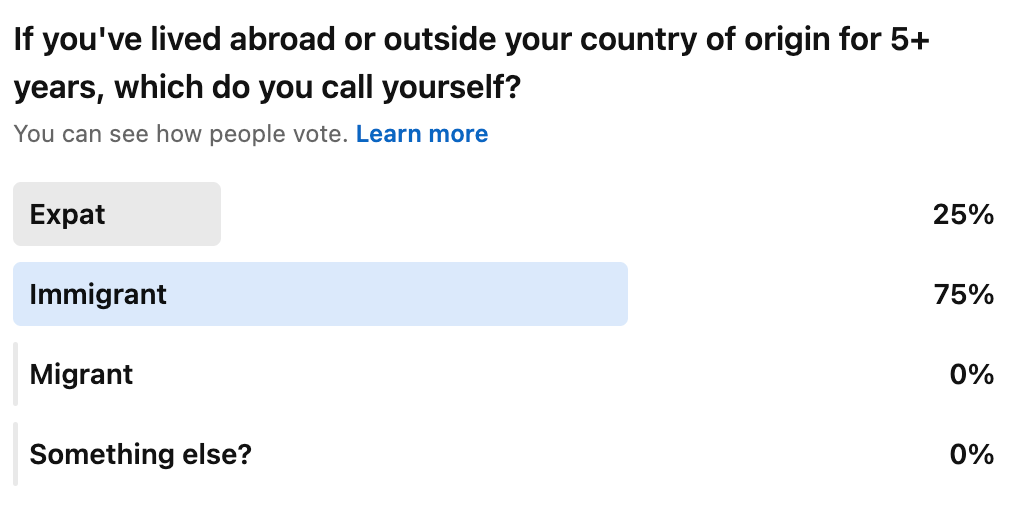
So if you find yourself hesitating before answering — or giving different answers depending on the room you’re in — that’s not inconsistency.
It’s an honest response to a genuinely complicated question.
You don’t need to resolve it. You don’t need to find the right word and commit to it forever.
Sometimes the most grounded thing you can do is notice which word fits today, and leave room for that to change.
For now, noticing how you feel about each of these labels is enough.
Sometimes it helps to have that experience witnessed; you don’t have to make sense of it alone:
I hold a small number of Expat Orientation Conversations each month — 60‑minute, one‑to‑one, non‑clinical sessions for sense‑making and orientation, not therapy or coaching.
Together we look at how long‑term life abroad may be shaping your inner experience, find language for what has been hard to name, and gently sort what’s contextual from what’s personal before you decide what, if anything, you want to do next.
Let’s keep walking the edges together.
Onward,
Kay✨
Who’s behind Edgewalkers Collective?
I’m Kay — Filipina American TCK (Third Culture Kid), 17 years in Spain, and a counsellor‑in‑training (CPCAB, UK). I spent over a decade working in inclusion and cross‑cultural strategy, helping organizations bridge cultures. I was good at it. I was also quietly burning out from being the bridge. Now I’m training to offer something different: recognition‑based support for expats and global citizens who are done being told they should feel lucky to be here.
If you’d like a sense of what working together could look like, you can read more on the Work With Me page.
If you want to access to the guided audios and quarterly pattern reports from my long-term life abroad research I send to paid subscribers, you‘re welcome to upgrade your subscription at any time.
I have lived in Spain (and some Portugal) for almost 33 years. I have never felt the need to call myself anything. Not to myself or to anyone at all. I am just me, living where I live and being who I am. Maybe I have never spent time with people who use these terms. Most of my friends here are Spanish or Portuguese but in my work I also have friends from all over the world who live here. Or maybe since my entire life revolves around travel and being in other places, it is just my permanent state of being?
Thanks for sharing your thoughts. I enjoyed your article!
Even "expat" can be tricky when your "origin" is already complicated. I guess that's where "TCK" comes in? I love this piece, thanks for sharing. 💕