

Last month, I walked into the room as a caretaker of your long‑term life abroad stories — about to deliver an in‑person talk presenting the research these stories have shaped.
I left the stage with an audience member giving me a hug and a quiet sentence in my ear:
“You finally named what I’ve been carrying out loud. Thank you.”
Here’s what happened in between.
The research corpus
If you’ve been following Edgewalkers Collective from the beginning, you’ll know that I’ve been conducting research conversations into the long-term life abroad experience — alongside my CPCAB counselling training.
Since kicking off these interviews, I’ve now held 35 conversations, hosted 1 in-person workshop in Madrid, and heard stories from people whose experiences span 49 countries. But by the fifth interview, I could already identify a clear pattern:
Globally mobile folks, migrants, TCKs, and returners kept describing what one of my research participants called the low-grade hum — an ongoing nervous system effort in the background to keep functioning across cultures, languages, and roles that don’t quite fit.
Many of the people I spoke to started to name this hum and this feeling of in-between-ness — what I call “chronic liminality” — around year five when settling into their chosen home.
As a bit of a lark, I applied to speak at an intercultural congress in Valencia to share more about the patterns that were emerging — with a room of people who think, talk, and write about this for a living.
I was thrilled when I received the email that it had been accepted.

The talk I delivered
The session I gave was called, “The Low‑Grade Hum of Life Abroad: Migratory Grief & Chronic Liminality for Long‑Term Expats.”
The room was full of intercultural trainers, psychologists, educators, and practitioners — people used to holding the frameworks, not being handed someone else’s.
I opened with the material I’ve been building since the start of this year, and how each of your stories helped shape my research. Not the first year landing, but year ten, twenty, or forty. The “no longer new, still not home” folks who’ve done all the visible integration steps — housing, work, friends, language(s) — and still describe feeling “slightly offshore” in their own lives. I shared the stories of:
The “trailing spouses” who had to get creative about how to build lives and families when moving abroad often meant leaving their own careers behind;
The multi-decade expats who’ve spent more of their lives in their adopted country than their passport country, and how they build their own belonging infrastructures to mitigate loneliness;
The returners who, after many years abroad, struggled with an often overlooked version of grief that their social systems didn’t have vocabulary for;
The single professionals who, on paper, looked like they were fully functioning in their lives and careers abroad — only for the prolonged nervous system strain to catch up to them in the form of hospitalization or burnout.
On the slides, I shared concepts and clinical research that most people in the room had met before. The U‑curve or W‑curve of cultural adjustment most of us have seen before — the honeymoon, culture shock, recovery, adjustment, and on return, a second dip before things settle. I named Achotegui’s seven griefs1 — of family, language, culture, land, social status, group belonging, and migration‑linked risk — as the partial, recurrent, and multiple layers of migratory grief that underscore long-term life abroad. It’s a clinically recognized grief that stays partially open because what’s lost still exists for you somewhere else.
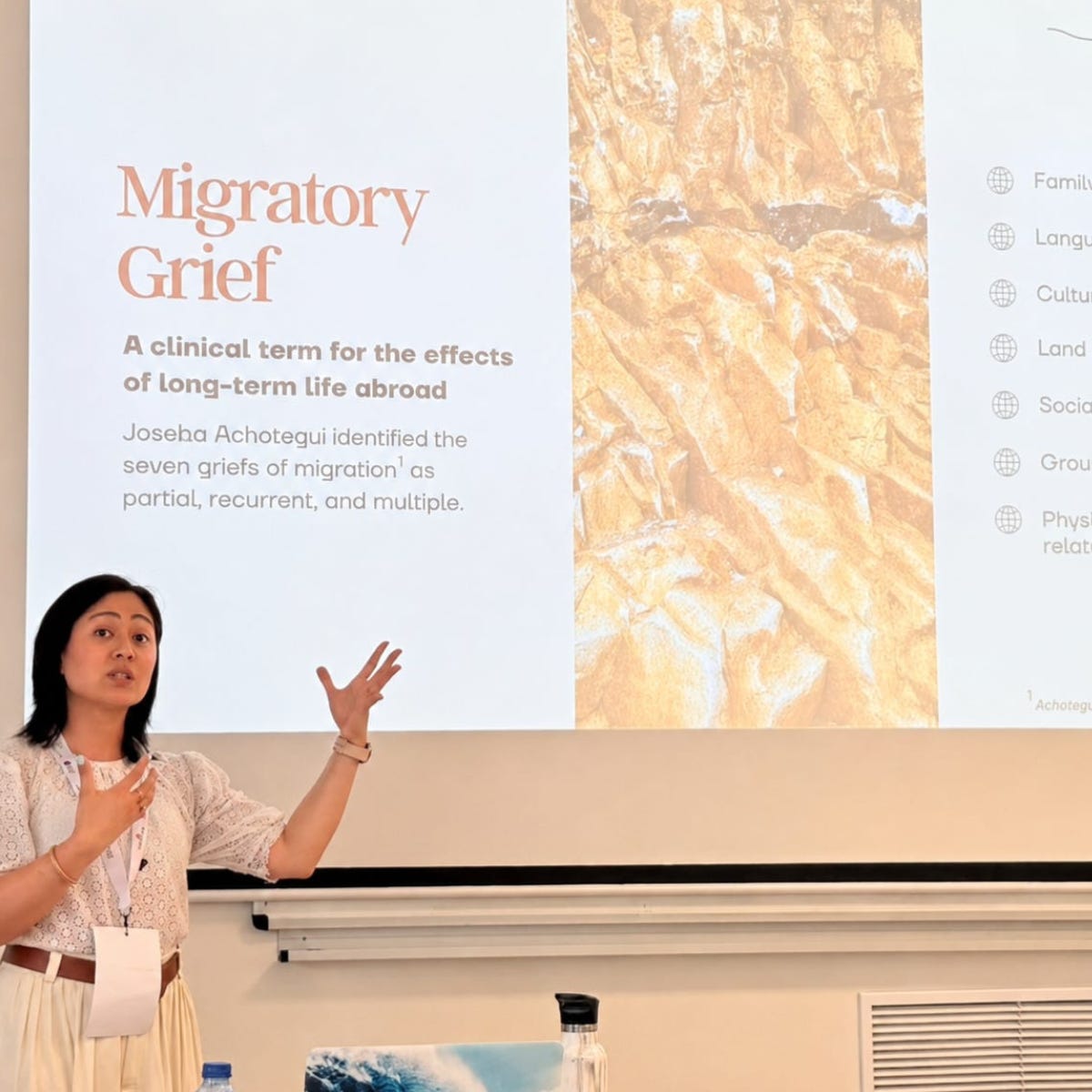
I also shared what both of those concepts miss:
The U-curve or W-curve of cultural adjustment both assume that integration is prize at the end of a linear journey. For the people I’ve spoken with, it’s less a curve and more an O: circling the same themes for years, never fully resolved, and easily mistaken for a personal failure to integrate.
The two decades of clinical research on migratory grief focuses primarily on labor migrants and refugees — whose grief has been shaped by significant trauma and loss through forced migration. For the people I’ve spoken with, choosing their home abroad over their passport country showed similar patterns of grief, loss, and nervous system strain.
The questions that surprised me
I expected questions about the frameworks or the research methodology. Instead, what I got were thoughtful expansions:
One person shared they often wished their multicultural identity story was more linear and easier to share with others — and that the talk led to their realization of the privilege it was to be able to experience the world through their different global lenses.
Another asked about the intersectionality of the research I was conducting, and whether it was considering marginalized identities in addition to countries of origin. I highlighted that while the low-grade hum seemed to be consistent in every population I had interviewed so far, the most marked difference was for Black Americans — whose nervous systems consistently showed less strain outside of their countries of origin. (This is on my list to be shared in a future essay…)
Someone else asked the question I get most, in different forms, from readers here too: “Why is it still hard after all these years?” I didn’t have a tidy answer. I had a reframe instead — what if the better question is: which parts of this life still require active effort, even though everything looks settled on paper?
After I wrapped up, most of the room started prepping for the next speaker’s talk — I heard the shuffle of laptops, notebooks, chairs scraping the floor.
One woman waited until after my talk ended, after I’d finished taking questions. Then she walked over, arms already slightly open.
I didn’t know her story yet. I didn’t need to, for what came next to land:
“You finally named what I’ve been carrying out loud. Thank you.”
She held on a beat longer than a polite conference hug usually lasts — long enough that I felt in my body what the last thirty minutes had only been describing in language.
On Substack, this hum is something I write about. In that room, for her, it became something she could finally put down, even briefly, because someone else was holding it too.
That’s the moment I keep returning to.

Grief & gratitude can co-exist in life abroad
At the conference, I shared one underlying pattern that came up in the research for long-term expats: their grief often comes “pre-apologized”.
What does that mean?
It means their grief shows up already justified, already minimized, already apologizing for its own existence before anyone’s asked it to explain itself. I heard versions of it throughout the research: I chose this, so I don’t get to grieve it. Other people have it worse. I know I’m lucky. The grief arrives with a disclaimer attached, as if permission to feel it has to be earned first.
That pattern — pre‑apologized grief — is a close cousin to what I want to name next, because I think it’s part of the same family, just wearing different clothing…
There’s another common pattern I’ve noticed, particularly for long-term expats of a specific generation, several of whom have written to me, both privately and publicly. Who’ve recognized the low‑grade hum immediately — but called it something else. One reader wrote, “I always considered it to be a positive thing, a sign of living life just a bit more intensely.”
I sat with that line longer than I expected to.
The hum can feel like intensity. Some days it probably is. But I’ve heard this reframe often enough now — vitality, the price of an interesting life, proof of having chosen well — that it’s started to feel like its own pattern.
It tends to show up in people who moved abroad decades ago, often by choice, into circumstances that were, by most measures, an upgrade. Which makes sense. If the move worked, if gratitude is the correct response, naming the grief underneath it can feel like betraying the choice.
But gratitude and grief were never in competition.
The gratitude of living abroad in a country you’ve chosen — what you’ve gained outside your passport country — is real. But the grief of what you’ve left behind is real, too. One doesn’t cancel out the other. It’s not about which one is right. Two things can be just true at once, and one of them has had a lot more permission to be spoken than the other.
You can love the life you built and still carry an unfinished thread back to the one you didn’t. Call it intensity if that word feels safer. Sometimes the hum feels most alive precisely because something underneath it hasn’t been let all the way down yet.
Either name is yours to keep. You just don’t have to pick one to be believed.

Why this research exists & what’s next
Edgewalkers Collective is here to build the vocabulary that lets people recognize what they’re carrying without having to justify it first, apologize for it, or perform gratitude as a condition of being believed.
Every story in this research — yours included, if you’ve ever written in to tell me I’d named something you hadn’t found words for, or pushed back because I hadn’t — is part of how that vocabulary keeps getting built. Even the pushback matters. Especially the pushback, honestly. It tells me where the pattern still has edges I haven’t fully mapped.
When have you felt the low‑grade hum in your life abroad? The version that lives in small moments… the pause before you answer where are you from, the room where your old status didn’t translate, the tiredness that never quite matches your calendar.
Tell me about your in‑between in the comments. (I read every one — and I suspect the rest of us will recognize ourselves in your story.)
This research is ongoing, and it only exists because people have been willing to sit with me and put language to things that don't usually get said out loud.
If you're a practitioner working with globally mobile clients, a researcher circling similar questions, or someone who recognizes this pattern in your own life and has a story that hasn't found its shape yet — I'd love to hear from you.
There's room in this corpus for your story too, however you name it.
And if you’d like to reserve your interview slot as someone outside your passport country for 5+ years:
Let’s keep walking the edges together.
Onward,
Kay✨
Who’s behind Edgewalkers Collective?
I’m Kay — Filipina American TCK (Third Culture Kid), 17 years in Spain, and a counsellor-in-training (CPCAB, UK). I spent over a decade working in inclusion and cross-cultural strategy, helping organizations bridge cultures. Now I’m training to offer something different: recognition-based support for expats and global citizens who are done being told they should feel lucky to be here.
If you’d like a sense of what working together could look like, you can read more on the Work With Me page.
If you already know you want to sit with this more regularly, you can upgrade to paid for monthly guided audios and quarterly pattern reports from my ongoing research interviews.
If this work is useful and you’d like to support it another way, you can buy me a coffee.
Achotegui J. Migratory grief, as partial, recurrent and multiple grief. Int J Fam Commun Med. 2024;8(2):44-47. Med Crave Online.
Black American here. 🙋🏾 We exist on Earth in specific ways.
Less stress in other countries that are not the United States, but with a multifaceted hum of both Blackness and Americaness embuing our interactions with new peoples and cultures.