

Last month, I walked into the room as a caretaker of your long‑term life abroad stories — about to deliver an in‑person talk presenting the research these stories have shaped.
I left the stage with an audience member giving me a hug and a quiet sentence in my ear:
“You finally named what I’ve been carrying out loud. Thank you.”
Here’s what happened in between.
The research corpus
If you’ve been following Edgewalkers Collective from the beginning, you’ll know that I’ve been conducting research conversations into the long-term life abroad experience — alongside my CPCAB counselling training.
Since kicking off these interviews, I’ve now held 35 conversations, hosted 1 in-person workshop in Madrid, and heard stories from people whose experiences span 49 countries. But by the fifth interview, I could already identify a clear pattern:
Globally mobile folks, migrants, TCKs, and returners kept describing what one of my research participants called the low-grade hum — an ongoing nervous system effort in the background to keep functioning across cultures, languages, and roles that don’t quite fit.
Many of the people I spoke to started to name this hum and this feeling of in-between-ness — what I call “chronic liminality” — around year five when settling into their chosen home.
As a bit of a lark, I applied to speak at an intercultural congress in Valencia to share more about the patterns that were emerging — with a room of people who think, talk, and write about this for a living.
I was thrilled when I received the email that it had been accepted.

The talk I delivered
The session I gave was called, “The Low‑Grade Hum of Life Abroad: Migratory Grief & Chronic Liminality for Long‑Term Expats.”
The room was full of intercultural trainers, psychologists, educators, and practitioners — people used to holding the frameworks, not being handed someone else’s.
I opened with the material I’ve been building since the start of this year, and how each of your stories helped shape my research. Not the first year landing, but year ten, twenty, or forty. The “no longer new, still not home” folks who’ve done all the visible integration steps — housing, work, friends, language(s) — and still describe feeling “slightly offshore” in their own lives. I shared the stories of:
The “trailing spouses” who had to get creative about how to build lives and families when moving abroad often meant leaving their own careers behind;
The multi-decade expats who’ve spent more of their lives in their adopted country than their passport country, and how they build their own belonging infrastructures to mitigate loneliness;
The returners who, after many years abroad, struggled with an often overlooked version of grief that their social systems didn’t have vocabulary for;
The single professionals who, on paper, looked like they were fully functioning in their lives and careers abroad — only for the prolonged nervous system strain to catch up to them in the form of hospitalization or burnout.
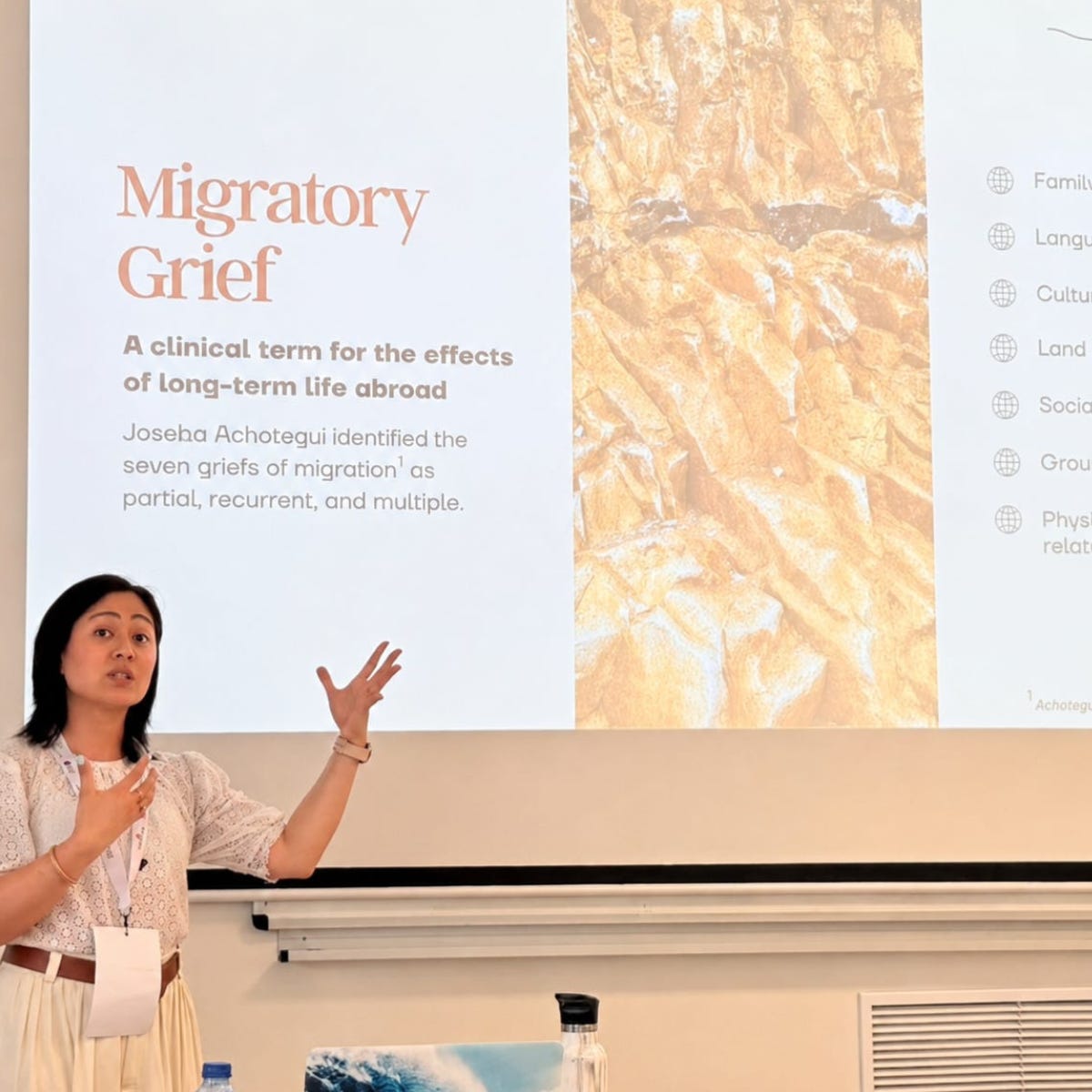
On the slides, I shared concepts and clinical research that most people in the room had met before. The U‑curve or W‑curve of cultural adjustment most of us have seen before — the honeymoon, culture shock, recovery, adjustment, and on return, a second dip before things settle. I named Achotegui’s seven griefs1 — of family, language, culture, land, social status, group belonging, and migration‑linked risk — as the partial, recurrent, and multiple layers of migratory grief that underscore long-term life abroad. It’s a clinically recognized grief that stays partially open because what’s lost still exists for you somewhere else.
I also shared what both of those concepts miss: